what happens to employees when private equity firm makes majority investment
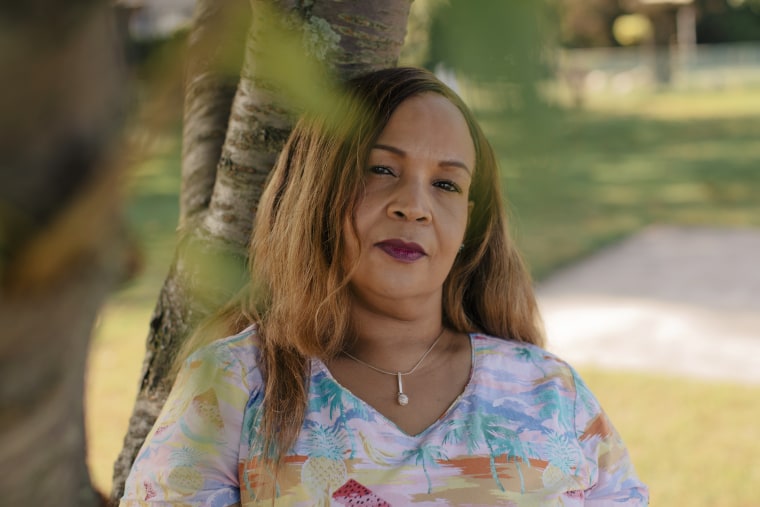
Alma Jordan, a certified nursing assistant at the Marcella Center nursing home in Burlington, New Bailiwick of jersey, respected the residents she cared for there over the past 16 years. They were like family unit, she said, and she believes they've appreciated her attentiveness, especially during Covid-19.
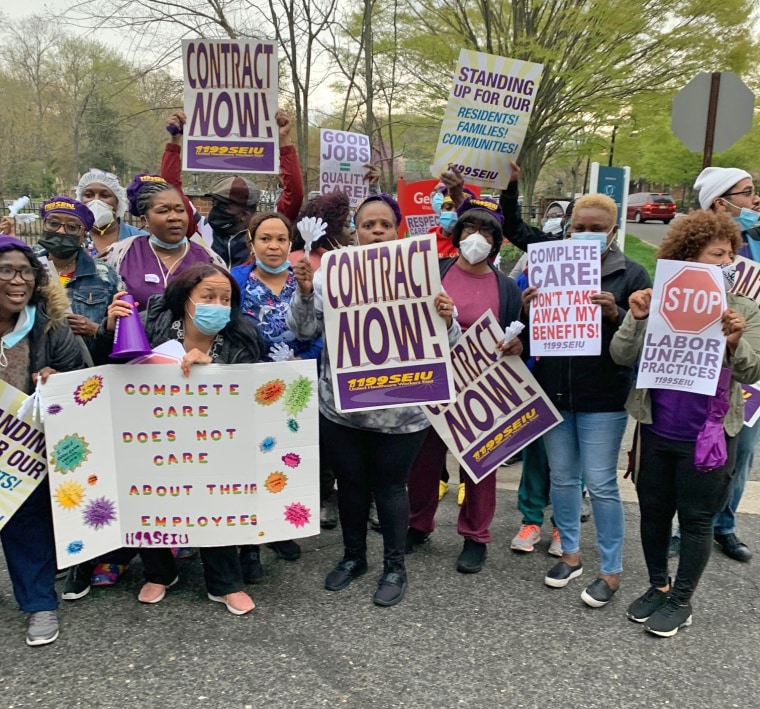
Not and then, the nursing home's new possessor, Jordan said. After Complete Intendance Management, the largest for-profit nursing home operator in New Jersey, took over the 150-bed Marcella Center in Apr, it slashed worker benefits, she and other employees also as a representative from their spousal relationship told NBC News.
Amid the pandemic, Jordan'south paid holidays were reduced, and her monthly health insurance costs more than tripled, she said. The visitor stopped contributing to the employee pension, replacing it with a 401(k) program that had no employer match or contribution. Complete Care took away vision insurance and stopped a reimbursement programme covering employee instruction costs, so Hashemite kingdom of jordan, 45, won't be able to recoup money she spent working toward a degree to become a licensed practical nurse.
"I put all my endeavour into this company, and someone else took over and they don't want to requite us what we deserve," Jordan said. "For them, it's business organization. Information technology's not about the staff and the residents. It's but about making profits."
In late September, Jordan quit her position at the facility. The reduced benefits and deteriorating work conditions got to be too much, she said.
When Consummate Care came in, Hashemite kingdom of jordan and other Marcella workers were operating under a spousal relationship contract struck with the facility's previous owner. Consummate Care did away with that contract, which too covered four other unionized New Jersey nursing facilities information technology recently acquired, according to the Service Employees International Wedlock.
Complete Care owns 61 facilities in eight states, including Connecticut, Maryland and Wisconsin. It is backed by a private-equity firm called Peace Capital in Lakewood, New Bailiwick of jersey, whose main owner is Sam Stein.
Jordan and her fellow workers are not alone in experiencing reduced circumstances subsequently their company is taken over by a private-disinterestedness firm. The new titans of finance, these firms use big pools of debt — typically raised in what'south called the leveraged loan market — to acquire companies they hope to resell in a few years at a profit. Among companies raising coin in this loan market during the past three years, debt levels at individual-equity-backed entities were at least 30 percent higher than debt levels at companies not backed past individual disinterestedness, according to LCD, a unit of South&P Global Marketplace Intelligence.
Just the heavy debt loads they take on, combined with pressure to flip acquired companies rapidly, increases the likelihood that private-equity firms will have to cut costs in the operations that they purchase. Often, the get-go to the chopping block is the company'south workforce.
A 2019 study past the National Agency of Economic Research lays this out. Researchers analyzed nearly 10,000 debt-fueled buyouts betwixt 1980 and 2013 and found that employment vicious past 13 per centum when a individual-equity house took over a public company. Employment declined by even more than — 16 percent — when individual disinterestedness acquired a unit or division of a company.

Eileen Appelbaum is an economist and co-director at the Heart for Economic and Policy Research, a progressive retrieve tank, and co-author of "Individual Equity at Work: When Wall Street Manages Main Street." Her report of private equity has led her to conclude that the industry's growing clout is non only a concern for workers, but also has the potential to damage the nation's broader economy.
"Yous accept a lot more ownership of productive resource past investors who don't know an industry, don't understand the value of skilled workers and who are just in it to make their profit and get out," Appelbaum said. "That erodes productivity."
Most 12 million employees, or roughly 7 percent of the U.S. labor strength, work for individual-equity-backed businesses, according to the American Investment Council, an industry lobbying grouping. These companies generated virtually vi.5 percent of the nation'south gross domestic production final year, the group said.
The council said individual-equity firms create jobs, support businesses and assistance provide comfortable retirements for pensioners invested in the strategy.
A spokeswoman for Complete Care echoed this view. She said the company is committed to the long-term viability of its facilities, adding in a statement: "We offer a comprehensive health plan and competitive benefits, and our facilities are known as great places to piece of work." The company is negotiating a new matrimony contract, the spokeswoman said.
Meanwhile, though, care at the Marcella facility is failing, Jordan said, days afterward she quit. "We were very short-staffed," she added. "And I call back the residents option upward on that because information technology takes longer to answer a telephone call."
In a statement, a spokesperson for Complete Care said, "Complete Intendance at Marcella consistently maintains state mandated ratios. ... Nosotros take whatever measures necessary to ensure that nosotros accept proper staffing to run across the needs of those in our care, including bringing in agency staff and offer bonuses as needed."
Taxed less than a teacher
Private disinterestedness is a sophisticated investment strategy that has grown furiously in contempo years. At the finish of last year, assets under management at the firms worldwide stood at $5 trillion, up from $1.five trillion over the past decade, according to Preqin, a financial data provider. The number of funds devoted to these activities has more than doubled during that period, and last year, private-disinterestedness firms paid some $600 billion to acquire companies, up from $250 billion 10 years earlier.
Private-equity firms began their climb to power in the 1980s; and so they were known every bit leveraged buyout shops, because of the debt they use. The $25 billion buyout of RJR Nabisco in 1988 by private-equity behemothic Kohlberg Kravis & Roberts brought such deals to center stage.
In contempo years, as prevailing interest rates complanate, private-equity operations have been able to have on greater amounts of depression-cost debt to make their acquisitions. Through Sept. 27, for example, $472 billion of leveraged loans were issued, up from $237 billion issued during the aforementioned period in 2019, according to LCD of Southward&P Global.

Outside investors, such as public pension funds and endowments, pour money into these takeover deals in the hopes of generating loftier returns. Simply recently, as the stock market has roared, outsize returns in private equity have all but vanished, academic studies prove, and they are now in line with overall market functioning.
Nevertheless, more than companies are owned by individual-equity firms now than trade on the nation'southward stock exchanges.
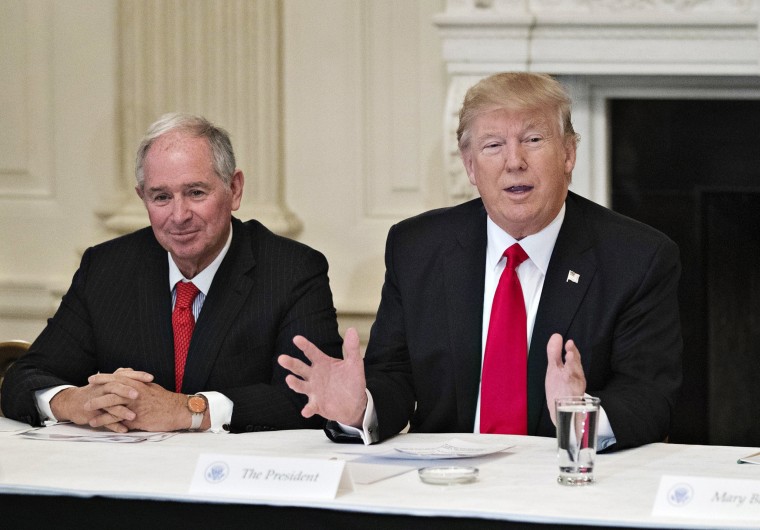
Not surprisingly, individual-equity firms' ascension dominance has generated immense wealth for their executives. The value of Sam Stein'due south holdings in Complete Care could not exist determined and the company declined to provide it, but it is almost certainly dwarfed by those of Stephen Schwarzman, caput of Blackstone Grouping. A close adviser to Donald Trump during his presidency, Schwarzman is worth $35 billion, according to Forbes magazine, up from $15 billion in 2020.
Private equity likewise benefited from recent authorities interventions related to the Covid pandemic, documents prove. At least $5 billion in federal bailout money went to companies backed by large and well-capitalized private-equity firms, according to a contempo report from Americans for Financial Reform.
Last twelvemonth, the Federal Reserve Board launched an unprecedented $750 billion program to prop upwards the corporate bail market, where many of these firms heighten coin for their buyouts. Among the bonds purchased by the Fed, documents testify, were those issued by Blackstone and another private-equity giant, Apollo Global Management, founded past Leon Black.
Gary Gensler, the chairman of the Securities and Commutation Committee, recently testified that the agency would increment its scrutiny on fee disclosures and conflicts of interest amidst private funds, to ensure their practices don't put investors in these strategies at a disadvantage. And Lina Khan, the new chairwoman of the Federal Merchandise Committee, said in a late September memo outlining the agency's priorities that "the growing role of private equity" invites an examination of how these firms' business concern models "may facilitate unfair methods of competition and consumer protection violations."
Finally, the Democrats' proposed tax increment on capital gains may crimp private-disinterestedness executives' earnings. A key reason many of these executives have been able to amass such fortunes is that so much of their earnings are taxed every bit capital gains with a acme charge per unit of 20 percent, not at the higher 37 percentage rate that tin apply to income. This is a benefit they've tapped for decades, oft allowing them to pay a lower taxation charge per unit on earnings than a secretary or a teacher might.
7,800 signatures
I of the nation'south biggest individual-equity employers is Roark Majuscule of Atlanta. It owns Inspire Brands — parent company to an array of fast-food chains that includes Arby's, Dunkin', Baskin-Robbins and Sonic — and other brands such equally Cinnabon and Seattle'southward Best Coffee.
NBC News estimates that more than 700,000 people work at Inspire Brands, many at independently endemic franchise stores.
Roark is named for the libertarian protagonist in "The Fountainhead" by Ayn Rand, whose life "exemplified the qualities of independence and integrity," the visitor's website said.
Ane of libertarianism'southward bones tenets is express regime, merely three dozen companies owned by Roark obtained $183 1000000 in federal assistance under the CARES Act, according to the Americans for Financial Reform report. Asked whether this credence of government funding ran counter to a limited authorities stance, Roark declined to comment through a spokeswoman.
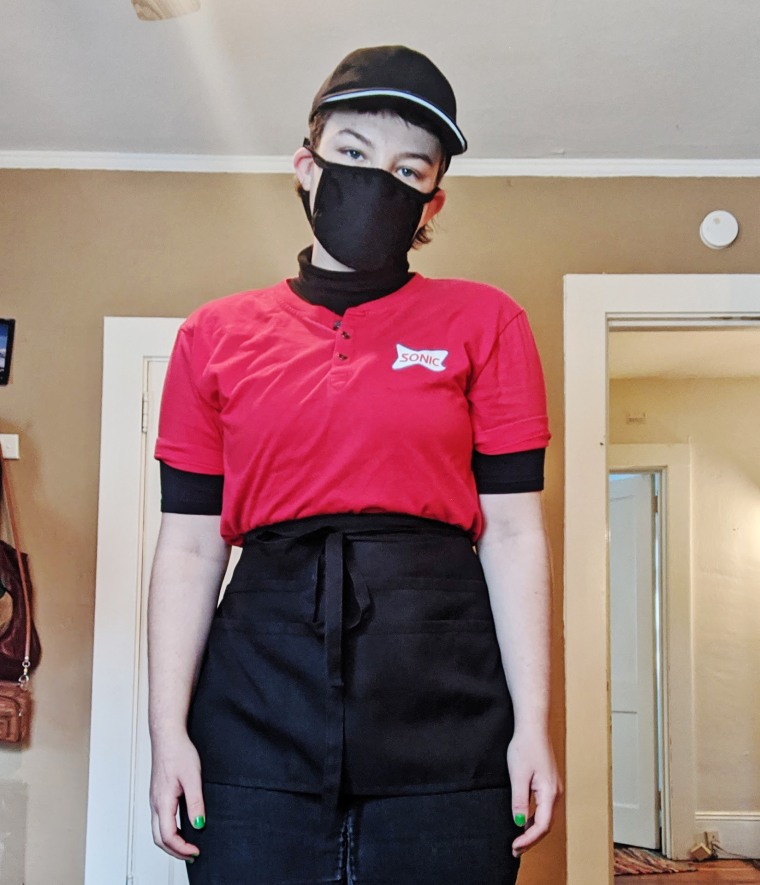
Zella Roberts, a recent graduate of Warren Wilson College well-nigh Asheville, North Carolina, worked equally a carhop at a Sonic Bulldoze-In earlier this year to help pay tuition. Her all-in pay plummeted during the pandemic, Roberts told NBC News, considering customers' cash usage fell and Sonic did not let tips on credit cards.
Roberts said she and some colleagues sent an email to Roark Majuscule "explaining the conditions that Sonic workers experience. The big ask was to put pressure level on Sonic corporate to make these changes." She said she never heard back about that or other messages sent to Neal Aronson, managing partner and founder of Roark Upper-case letter. Aronson is the controlling possessor of Roark, regulatory filings prove, which has $18.6 billion in avails under management.
Through a spokeswoman, Aronson declined to annotate.
In Jan, after Roberts had nerveless 7,800 signatures on a petition asking Roark to change its policy, the visitor allowed tips on credit card orders placed through its app. An improvement, Roberts acknowledged, simply such orders are a small percentage of those made via credit cards, she pointed out.
The Inspire Brands spokesman said barring tips on credit cards "is a engineering limitation that we inherited when we purchased the make" in 2018. "We are now working on implementing the credit card tipping capability," he said.
Inspire Brands has also worked to battle the Enhance the Wage Human action, which has been introduced in Congress every year since 2017 and would increase the federal minimum wage to $fifteen an hour amongst workers like Roberts. In March, Inspire sent a memo to franchise owners highlighting its lobbying success in opposing the alter. Describing its efforts, Inspire said: "If you don't accept a seat at the table, you're on the menu, and you tin can guarantee your opponents are eating!"
Chris Fuller, a spokesman for Inspire Brands, said the visitor fought the national minimum wage legislation because "we don't support a one-size-fits-all approach to the minimum wage. We believe in letting the local markets dictate." He added: "More than than 90 percent of our team members at corporate-owned restaurants are above the state or local minimum wage."
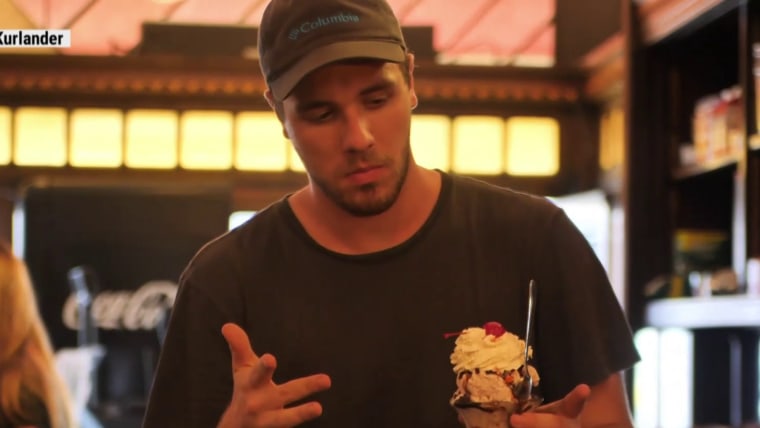
Some Inspire Brands workers have taken matters into their own hands. This summer, Matthew Honeycutt, eighteen, was working at an Arby's in Charlotte, North Carolina, making $9.50 an 60 minutes as a shift manager. He supports an eight-month-one-time son.

On July twenty, he and a grouping of workers walked off the task seeking a pay raise, forcing managers to close the Arby'due south store 2 hours early on, Honeycutt said.
That got management's attention, he said. "The strike was on a Tuesday, and it was about Thursday when he started getting the raises out," Honeycutt said of his boss, who gave him a 50-cents-an-60 minutes raise. "Every kind of worker you can recollect of is working and so hard, but they're non getting paid what they're worth."
Honeycutt's boss did not reply to a voicemail message seeking comment. In mid-September, Honeycutt quit his job at Arby's for a higher-paying position elsewhere.
While Inspire Brands fights against a higher minimum wage, another eatery companies owned by publicly traded companies are taking a different approach. They say increasing worker pay is good for concern.
In February, Robert Verostek, the chief financial officer of restaurant concatenation Denny's, told investors that paying a higher wage to its workers in California had resulted in "non just positive sales, but positive guest traffic."
And in May, McDonald's began increasing pay by 10 per centum for about 37,000 workers in company-owned stores. Shift managers like Honeycutt, who earned $10 at Arby'southward, are earning between $15 and $twenty an hour depending on the location, McDonald's said.
Sean Dunlop, an disinterestedness analyst at Morningstar Research, said Inspire Brands is a well-managed company. But increasing pay and benefits among workers is an industry trend information technology won't be able to resist.
"As you're thinking about bigger chains, not only are they making a broader push to a $15 average wage at restaurants, you lot've besides seen them offer tuition help, paid time off, retentivity bonuses and referral bonuses as they've been trying to attract workers," Dunlop said. "Inspire Brands, if they want to compete, are going to exist forced to enhance wages. They're going to have to, whether they want to or not."
lerouxtiledgets78.blogspot.com
Source: https://www.nbcnews.com/business/personal-finance/working-companies-owned-well-heeled-private-equity-firms-can-mean-n1281146
0 Response to "what happens to employees when private equity firm makes majority investment"
Post a Comment